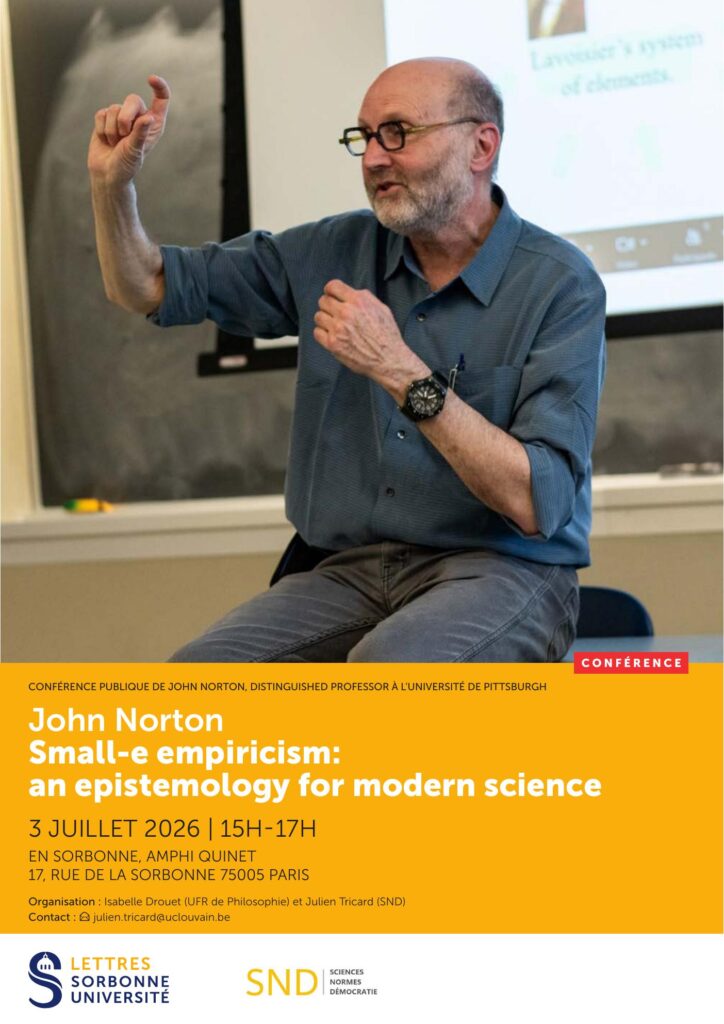
Conférence de John D. Norton “Small-e empiricism: an epistemology for modern science” – 03 Juillet 2026
Chères et chers collègues,
Pour rappel : John D. Norton (Pittsburgh, USA) donnera une conférence à Sorbonne Université le vendredi 3 juillet 2026 (Amphithéâtre Quinet, entrée par le 46, rue Saint-Jacques, niveau C, 75005 Paris).
La conférence sera retransmise : https://rendez-vous.renater.fr/Conference_de_John_Norton_small-e_empiricism_a0d380-36fdd5-1242ea (pas de mot de passe, connexion libre)
John Norton développe depuis plusieurs années une nouvelle théorie des inductions scientifiques, la « théorie matérielle de l’induction », exposée dans deux ouvrages majeurs : The Material Theory of Induction (University of Calgary Press, BSPS Open, 2021) et The Large-Scale Structure of Inductive Inference (University of Calgary Press, BSPS Open, 2024). Sa venue à Paris coïncide avec la finalisation de son dernier ouvrage, où il développe une nouvelle théorie empiriste de la connaissance scientifique, et dont une première version est disponible ici : Small-e empricism.
Quand ?Vendredi3 juillet 2026, de 15h à 17h.
Où ? Sorbonne Université, Amphithéâtre Quinet ; entrée par le 46, rue Saint-Jacques (niveau C), 75005 Paris (Cf Plan ci-joint).
Inscription obligatoire (pour entrer dans le bâtiment) : par mail (julien.tricard@uclouvain.be) avant le 2 juillet au soir
Titre : « Small-e empiricism: an epistemology for modern science »
Résumé : The core principle of small-e empiricism is that we can only learn the contingent truths of science from experience. We learn such truths by inductive inference, where empiricism itself encourages a material conception of inductive inference.
Small-e empiricism discards as needlessly skeptical the added assumption of Big-E Empiricism that all we can learn from experience is the content of experience itself. Small-e empiricism agrees with modern science in its epistemic optimism: we can have strong inductive evidence from experience for the core propositions of our sciences. Since the excitations of human sense organs are being replaced almost everywhere in science by fully instrumental sensings, small-e empiricism characterizes experience as a physical process that connects continuously with the system of interest. This revised concept of experience escapes the troublesome problem of distinguishing experience from theory since it has no such distinction. In its place is a comparative relation of being closer to the system of interest in the experiential process. The authority of experience does not derive from a primacy of human experience, as is the case with Big-E Empiricism, but from the physical continuity with the system of interest of experiential processes.Isabelle Drouet (Sorbonne Université) et Julien Tricard (Jean Moulin Lyon3)